
What is the Relationship Between Human Intelligence and AI?
With SpaceX shares expected to start trading on the Nasdaq stock exchange on 12th June, and Anthropic & OpenAI following soon, it is time to speak up about this subject.

Here is an article I wrote and shared privately on 26th April 2024:
Expectations about AI
Elon Musk, CEO of Tesla, SpaceX and other ventures, said during a live interview at the New York Times Dealbook Summit on 1st December 2023:
The world is less than three years away from AGI — and it will have the ability to “write as good a novel as J.K. Rowling, discover new physics, or invent new technology.”
Mr Musk keeps repeating similar claims.
On 11th April this year, I replied on X as follows:
@elonmusk says “If you define AGI (artificial general intelligence) as smarter than the smartest human, I think it’s probably next year, within two years,” So when will it replace @elonmusk as CEO of his various ventures?
This was greeted with complete silence, even though, if Mr Musk really believes what he says, his fiduciary duty to his shareholders ought to oblige him to stand down and be replaced by this AGI. After all, it is unlikely to demand a bonus of $55 billion for its work, unlike Mr Musk, who thinks he needs the money to make us a multi-planetary species.
Artificial Intelligence (AI) has been around for many years, although practitioners in the field cannot agree amongst themselves what they mean by the term. There is even more disagreement about the matter of Artificial General Intelligence (AGI). Since the public launch in November 2022 by OpenAI of ChatGPT, the level of publicity, especially around claims of either utopia or dystopia being just around the corner, has reached a crescendo and caused stock market mania.
What is Human Intelligence?
So, let us step back and consider what Human Intelligence is.
In a modern so-called Developed Society, humans operate through five Moral Modalities, at three levels of Recursion, as shown by the following table:
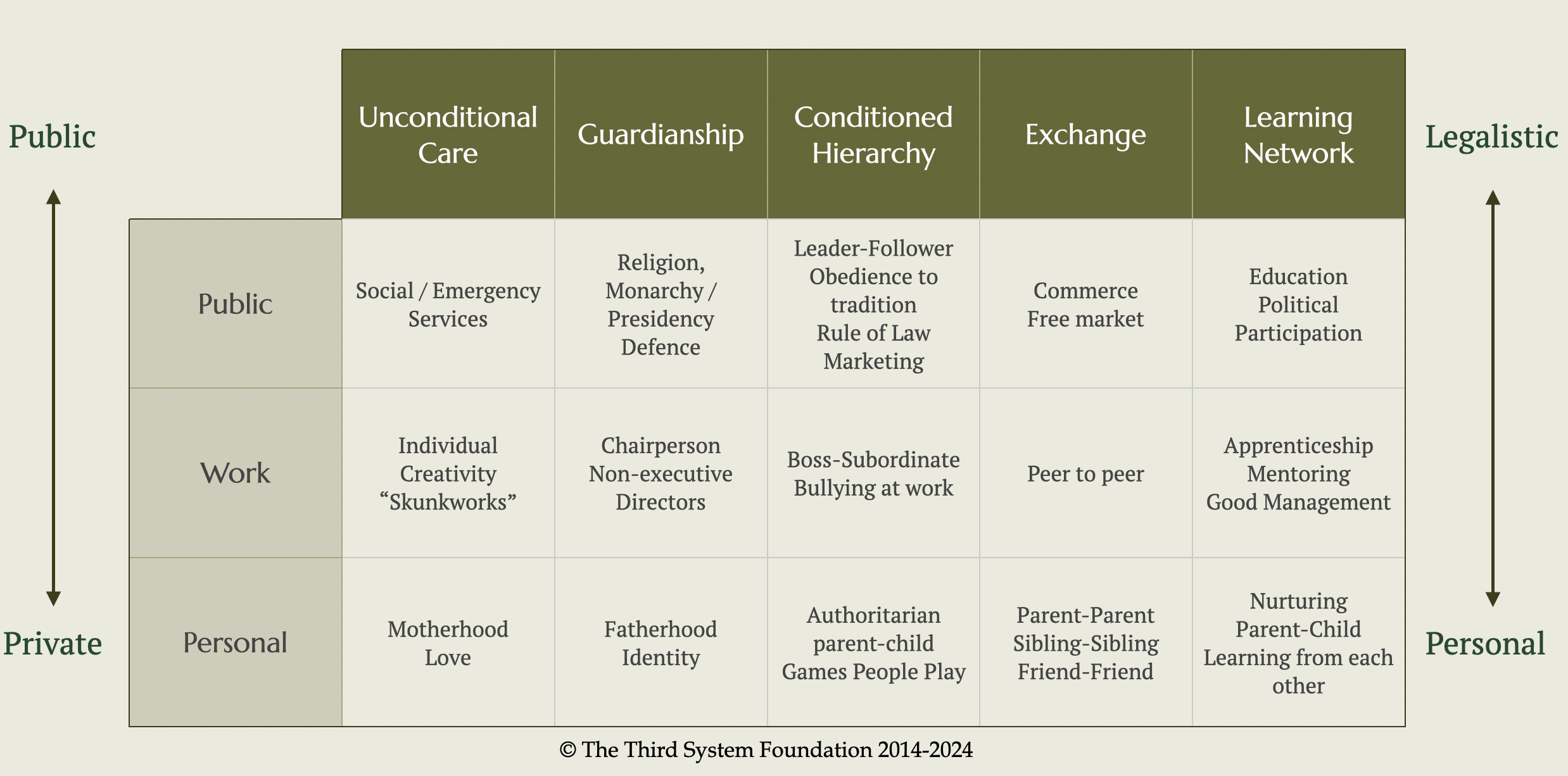
The columns in this table represent the five Moral Modalities, and the rows show three levels of Recursion, representing the Personal, Work and Public spheres of activity.
These five Moral Modalities are based on a considerable amount of research in anthropology, behavioural economics, sociology, psychology and cybernetics,
We only have space here to briefly summarise what these Modalities are:
Unconditional Care – the Foundation of Being Human
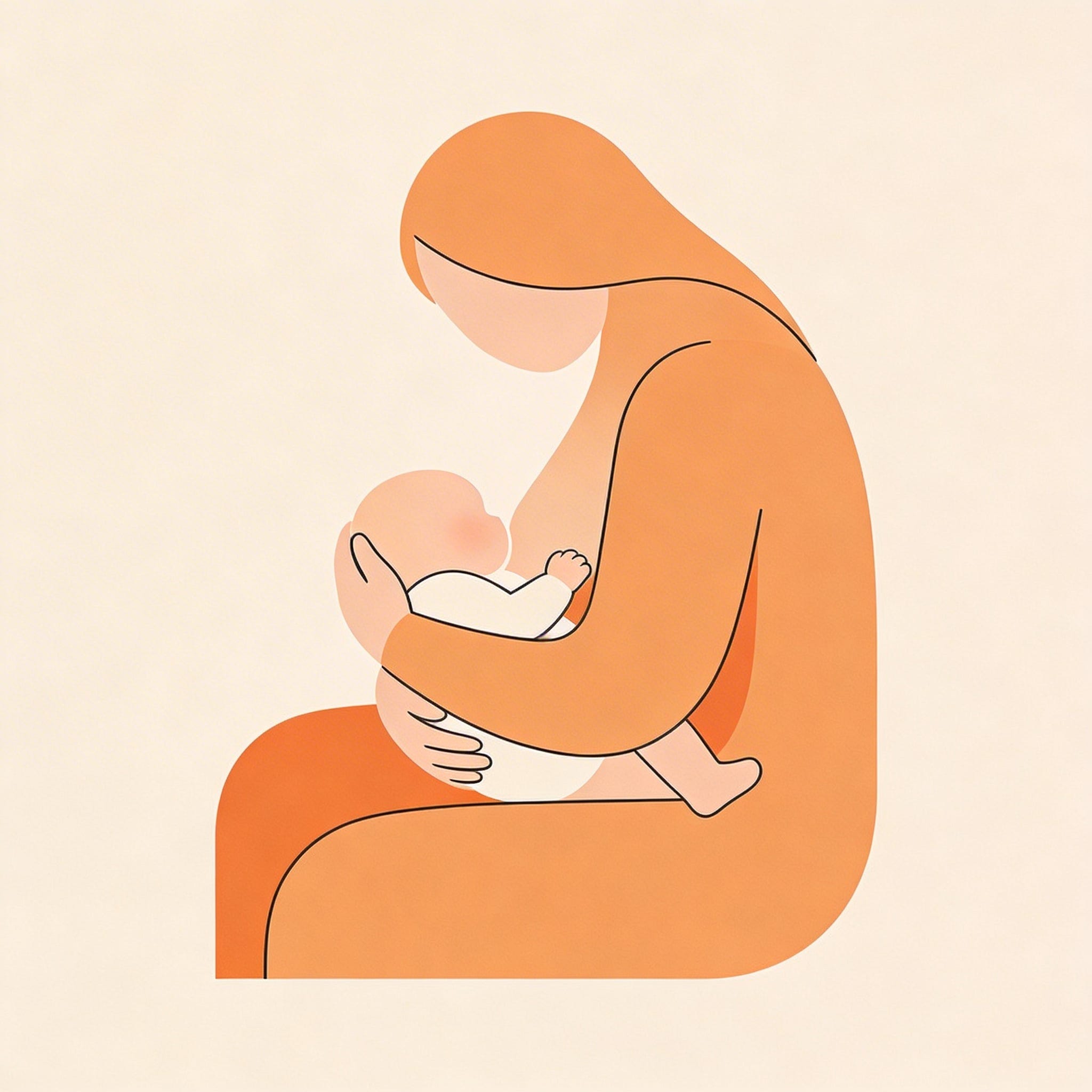
The Unconditional Care Modality underpins everything else in human life.
The archetypal symbol of this is a mother breast-feeding a baby.
In this modality, we recognise something that needs to be done and act without consideration for whether we will be rewarded or punished for it. We can see that it needs to be done, so we do it.
At the personal level, this expresses itself in caring for those we love. We do not do so for what we can get out of it, we do it because that is what it means to be human.
In the world of work, this expresses itself as creativity. Most creativity takes place inside individual minds, but there is a form of social organisation that can scale this up without losing the creative spark. We do not have space here to say more about it.
At the level of public life, this expresses itself as social services, health care and emergency services.
Guardianship – Deciding Who We are
The Guardianship Modality is about establishing the boundaries around the social group. Who is inside and who is outside? The archetype of this is the story teller, who tells the members of the group who they are and what their values are:

At the personal level, this was traditionally the job of the father, but it does not have to be attached to a specific gender.
At the level of work in a typical Western-style environment this is the job of the Chair and Non-Executive Directors, or the Founding Entrepreneur.
At the level of public life, this guarding of identity is in the hands of priesthoods, monarchs or presidents and the defenders of the realm.
Conditioned Hierarchy – Keep on Keeping On
In the Conditioned Hierarchy Modality, we are going about ordinary life, mostly without reflecting on what is happening. We get up when the alarm goes off, walk the dog, commute to work, do what we need to do, come home to the family, get the kids to do their homework, watch the TV, and check in on our social media.
We are following our training, operating almost on auto-pilot.

Conditioned Hierarchies have fixed value systems. If we stray from the path, we feel guilt or shame. There are leaders and followers. There is a hierarchy of prestige, with reassuring authority figures who will guide us and keep us safe. There are accepted assumptions that must not be challenged.
There is also competition. If we work for General Motors, we know that Ford is the enemy. If we follow the Manchester United soccer team, we know that Liverpool is the traditional foe. We get immense pleasure out of belonging to our side and the competition with the “enemy” is a great source of emotional stimulus for all participants.
In the field of commerce, the dark arts of marketing are used to make sure we keep buying the right brand. After all Coca-Cola is “The Real Thing”, isn’t it? When marketing works, buying the product is a “no-brainer”.
Conditioned Hierarchies are a powerful way to “deliver the goods”, as long as the environment doesn’t change. But when it does, they can become dangerous. When the environment changes, it is likely that nobody in the Conditioned Hierarchy will realise this. When things start to go wrong, they will assume that this is because people are not working hard enough. The authority figures will “crack the whip” and demand more obedience, often continuing to do so until the organisation collapses.
Exchange – Let’s Make a Fair Deal
In the Exchange Modality, I have something that you want, you have something that I want, and we figure out a deal to exchange one for the other. This is the world of free market economics, although free markets are less common than most of us imagine.
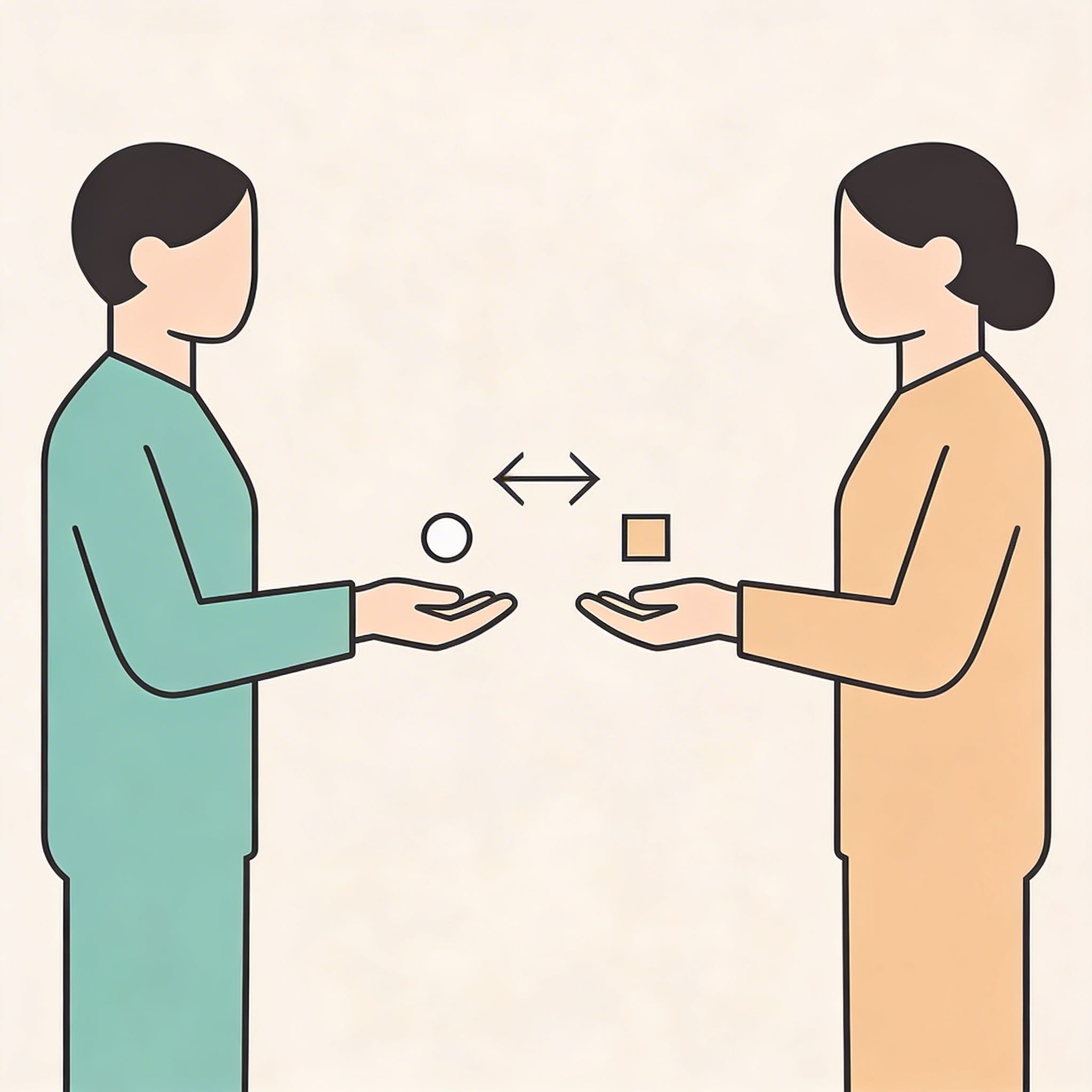
The modern world since the eighteenth century has grown out of an emphasis on the combination of Conditioned Hierarchies and Exchange. Adam Smith, who is credited with being the founder of free market economics, described a pin factory, which increases productivity by division of labour (a classic Conditioned Hierarchy), and producers competing in a free market (Exchange), as examples of how a free market economy creates increasing wealth.
Learning Network – The Organ of Evolution
The Learning Network Modality is subtle, but important.
In this modality, people learn from each other without any assumptions of higher or lower prestige. Authority flows according to who at any moment knows more than anybody else.
Those who wish to learn have to be prepared to subordinate themselves to whoever is teaching them, but success in the interchange abolishes the authority hierarchy, because the participants become peers in that particular aspect of knowledge.
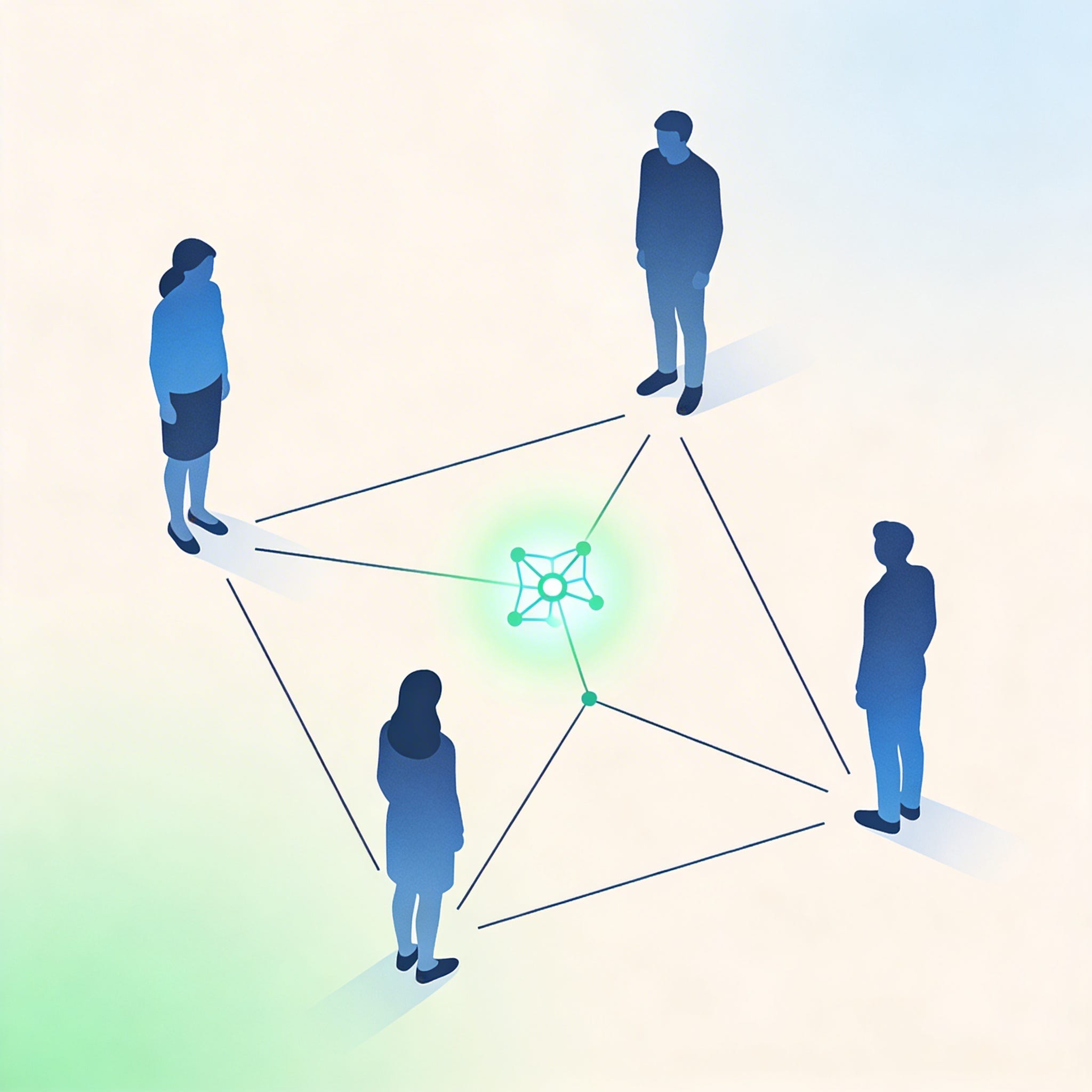
Learning Networks enable new knowledge to be developed and distributed throughout a social group, enabling them to evolve and adapt to changing circumstances.
Historically, these are vitally important, but they are also poorly documented and hard to see, because they tend to dissolve, once a new level of learning has been reached, and get replaced with a Conditioned Hierarchy, which then takes the credit for what happened.
How We Shift Between Moral Modalities and Levels of Recursion, but Sometimes Don’t Realise We Are Doing It
We normally switch effortlessly between the Moral Modalities and levels of recursion without noticing we are doing it. This seamless switching is what makes human life rich and fascinating.
But when asked to identify intelligence, we tend to think of highly articulate people scoring highly at quiz shows such as University Challenge in the UK or scoring points in clever debates in the Houses of Parliament.
The UK recently experienced what happens when we allow such “high performers” to run the country, as exemplified by the 49 days in power of Prime Minister Liz Truss and her Chancellor Kwasi Kwarteng (who did compete on University Challenge in his youth).
Here is a story from the Central Asian Sufi tradition that might help us to see this kind of thing from a different cultural perspective:
Psychoanthropological Report
THERE IS A country where all the people are eccentric for part of the time. They are not at all like the human beings whom we know.
They train groups of people to behave in certain systematic manners. When this has been done, they elicit that behaviour and all its surrounding actions, by applying the necessary stimuli.
Those people who show the greatest efficiency in training, the best indoctrination subjects, are given rewards, just as are laboratory animals who successfully reproduce their conditioning plan.
But at this point, unlike us, these people become quite confused, in the most systematic manner: the trainers themselves, instead of saying, ‘Another experiment successfully completed,’ start to admire and worship the ‘heroes’. They set them up as inspirers, actually claiming that what they did was ‘spontaneous’.
The result is that anything really spontaneous is punished and disliked, and cannot survive in their society. But as they have the word left over, they use it for non-spontaneous things.
This is all such a pity, since they are at times very pleasant people to be with, having far greater capacities than this self-deceptive one. And theirs is, to many visitors, a beautiful country. Because of the drawback just described, of course, most people who do not have to go there avoid it. They become irritated, noting that the citizenry of this place actually have scientists who carry out clinical and experimental work on animals and humans without noting similar effects in everyday society. This they claim is the experimenting and conditioning. But what they do among themselves, something precisely the same, after laboratory hours, that is not.
But are the results of the scientists’ indoctrination processes secret? Good gracious, no! They are printed by the million in popular books, and very widely read.
We are lucky to live in our kind of world.
From The Magic Monastery by Idries Shah
This is, of course, a description of the Conditioned Hierarchy Moral Modality, which Western Society employs to great effect just about everywhere, and has been doing so for about five hundred years. it flattens out the diversity of real experience and tends to dismiss as “subjective” any aspects of life that can’t be reduced to simple metrics, which often turn out to be about money.
It is interesting to note that in this world, powerful people, such as Elon Musk, tend to need motivating by ever-increasing monetary rewards for their “merit”. while poor people are expected to be motivated by the threat of even greater poverty and to accept being replaced at work by AI-driven robots, in the pursuit of “rational capitalist efficiency”.
So, what have the Moral Modalities to do with AI?
The Conditioned Hierarchy Modality is sustained by the very human tendency to follow powerful, prestigious figures, and for people to compete to climb “a greasy pole” to attain such status.
This is carried on by training people to conform to social expectations, which is essential to sustain any community, and is the main method by which knowledge gets transmitted down the generations.
But this Modality does not enable new knowledge to emerge and is often hostile to the Learning Network Modality, which does.
The fact that Large Language Models (LLMs), such as ChatGPT, require to be trained on vast masses of training data is the clue to the fact that they really only operate in the Conditioned Hierarchy Modality and have nothing to contribute to the other Moral Modalities, all of which are as essential to human life as that one is.
If I am right about this, we can expect to see the law of diminishing returns setting in quite soon, as more and more computing power and training data is thrown at supposedly making LLMs even more intelligent than they are now.
This is the equivalent of believing that, if one aspirin tablet cures my headache, a thousand will give me Enlightenment.
Why Are So Many Intelligent People Taken in by the Dream of AGI being Just Around the Corner?
Many researchers in AI joined the field because they were inspired in childhood by ideas from science fiction stories of a galactic civilisation populated by intelligent robots.
For example, Elon Musk was inspired by The Hitchhiker’s Guide to the Galaxy by Douglas Adams and thinks he has a moral obligation to make us a multi-planetary species.
Many people have been inspired by the idea that The Singularity is near, when machine intelligence will exceed human intelligence and we will all live forever, perhaps All Watched Over by Machines of Loving Grace as in the poem of that name by Richard Brautigan.
The field of AI has not been much informed by knowledge of social psychology, which perhaps explains the confusion about the nature of human intelligence.
The key mistakes that seem to have crept in are based on the following common assumptions:
The human mind can be reduced to the human brain.
The human brain is just a computer.
Moore’s Law means computers are doubling in performance every two years or so, so there will come a time when the computers are “smarter” than humans.
In reality, items 1 and 2 are assumptions for which there is no evidence, not self-evident truths.
What Traditional Human Stories Illuminate the Real Issues?
There are far too many to enumerate here, but I think the story of the Israelites in the desert making a Golden Calf to worship, while Moses is on Mount Sinai communing with God accurately describes the current situation.
My Conclusion
There is no doubt that AI has much to contribute to the future of civilisation, but to make proper use of it, we need to maintain a realistic perspective and escape the trap of cultish expectations, which are driven by fear, hype and the greed for super-sized returns on investments in this latest supposed panacea for all our ills.
AI has its place, perhaps in replacing our tendency to demand social compliance from people, since such compliance only pits them against this latest development of our technical infrastructure instead of equipping them to thrive across the full spectrum of human experience.
We need to forget the fantasy about AGI being just around the corner, and not enslave ourselves to a world of compliance with authority figures backed up by machine intelligence, whether those authority figures belong to the Chinese Communist Party, Global Corporations or any other entity that demands that we comply with its imperatives.
It might help if those authority figures learned to live a more prosperous and rounded life instead of pursuing such narrow and unbalanced aspirations as they currently dedicate themselves to.
I’ll Have More to Say on this Subject
The above is what I wrote in April 2024.
I think it still stands up pretty well, but I have learned more about the field of AI since then, and will soon have more to say, following up on this post…
I'm intrigued to know how professional unconditional care manifests as creativity. Does it not just manifest as care in the work place?