
Designing Freedom – 2
How to Design Organisations that Enhance Freedom, rather than Suppressing it

This is the second of two posts about Designing Freedom
The first post is here.
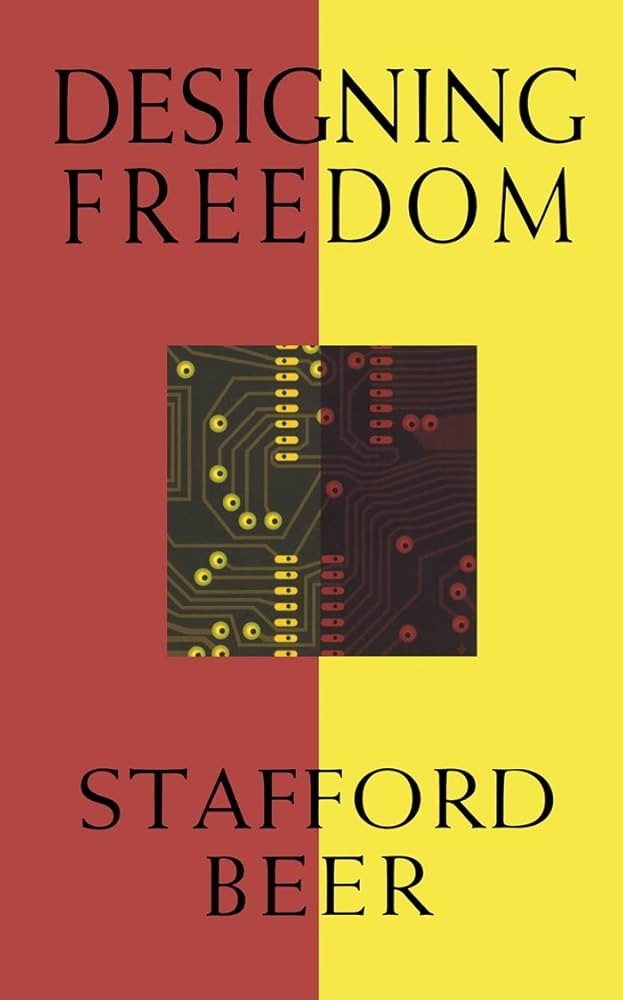
In November 1973, Stafford Beer presented the annual Massey Lectures broadcast on Canadian Broadcasting Corporation radio, in the form of six half-hour talks, one broadcast every night for a week, which you can listen to here.
Since 1961, the Massey Lectures have been Canada’s Premier Public Intellectual Forum, with the most distinguished figures talking about the most important topics of the day. Those figures have included J K Galbraith, Dr. Martin Luther King Jr, R. D. Laing, Claude Lévi-Strauss, Jane Jacobs, Willy Brandt, Doris Lessing, Noam Chomsky and Margaret Atwood. It was therefore a great honour and a sign of his high social status, when Beer was invited to present these talks.
Beer’s lectures were published as this book with the same title as the Lectures, with notes at the end of each chapter, illustrated with his own drawings.
I will now summarise the last three talks:
IV Science in the Service of Man
The scene is a small airport at a vacation resort where a week-end conference on automation has been held for senior business-men. Everyone is going home. The man in front of me at the desk finds to his horror that the flight for which he has a ticket is already full. “I am so sorry,” says the desk clerk soothingly. “We are having trouble with all the Flyaway Airline’s flights – something has gone wrong with their computer.” In the quiet of the little airport lounge, everyone is listening. A large man several places back in the queue leans forward and says loudly: “Excuse me, young man; I am a director of the Flyaway Airline. We do not have a computer.”
The opening paragraph
It is hard for us now to imagine an airline being run without computers, but this anecdote could easily have been true in 1973.
As I argued in the second lecture, the computer has come to represent a malign influence, and something of which people are frightened; therefore people are most unlikely to call on its aid, or to demand its use in the redesign of society.
Beer went on to explain what he meant by Science in the Service of Man, expressing his view that it was far too much in the service of vested interests who bamboozled the public into believing they could not understand it. Decisions therefore had to be directed by unaccountable technocrats, who knew better than we do what is good for us, even though most of the research was funded by taxpayers’ money.
According to the technocrats, what was good for us was:
Economic efficiency, irrespective of its impact on the industrial workforce, or the practicality of spreading it to developing countries.
The pursuit of conspicuous consumption, even when it makes people miserable, already visible in the increasing consumption of legal and illegal drugs.
Unlimited growth on a planet with finite resources.
What does this brief analysis purport to show? It argues that the sense in which people accept that science serves man is a false sense, since science is in these typical ways being used to destroy man – in his humanity and in his joy of living.
….
As the alienation grows, there is increasing resistance to the idea of yet more science, with the result that new proposals for handling old problems by the use of computers and telecommunications are often greeted with something approaching public hysteria. I am thinking of electronic files on the citizen, or the kind of governmental control system that I described earlier. The point is that this panic is well justified, so long as society continues down the existing path, following its technological nose. Yet if societary institutions are to escape the fate of catastrophic instability, we shall very certainly need new systems of these kinds.
It follows that science has to be handled in a new way. There is only one solution that I can see. It is to remove the control of science and technology from those who alone can finance its development, and to vest its control in the people. As to scientists and technologists themselves, they are truly servants of that public; whereas the present tendency is to turn them into an elite instrument of those who have the economic power over scientific systems themselves. That way lies technocracy, and we are perilously close to it already.
Beer goes on to suggest that putting the power in the hands of the people is possible, by using the tools of computing and telecommunications to enable the public to educate themselves and learn how to specify the direction of scientific and technological research, rather than leaving these decisions to the “experts”.
Although he does not mention it, Beer had already assisted in the setting up of the Open University in the UK, which taught using the medium of TV.
For this new channels are needed. But of course they could be set up. What is television for? Is it really a graveyard for dead movies, or animated wallpaper for stopping the processes of thought? What is the computer for? Is it really a machine for making silly mistakes at incredible expense? What will be done with cybernetics, the science of effective organization? Should we all stand by complaining, and wait for someone malevolent to take it over and enslave us? An electronic mafia lurks around that corner. These things are all instruments waiting to be used in creating a new and free society. It is time to use them.
….
The societary use of science we have is threatening; it becomes oppressive and alienating. The societary use of science we could have is a liberation.
Beer goes on to describe the capability of the human brain to manage variety, which is vast, but limited by our shared mental models:
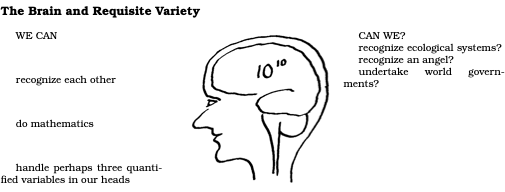
Can it be, perhaps, that we all suffer from a variety overload that we cannot map onto our models, and from an ungovernable oscillation in our search for mental equilibrium? In short, is our species facing the same threat of catastrophic instability as I earlier argued that our institutions are?.
….
I am tired of being told that the computer threatens our freedom, that cybernetics is a tool of the devil, that real-time governmental regulators are too dangerous to employ. The reason is that I reckon our existing liberty to be largely illusory: we are fooling ourselves. There is a new chance, now, to get our freedom back, even for us to bestow freedom on those who are following in our disastrous paths.
Beer identifies two sources of constraint on public understanding of our possibilities – our educational system and our methods of publishing information. He envisages using computing and telecommunications to create a self-organising version of these institutions, where any member of the public can educate themselves by going straight to the best sources of knowledge.
It is entirely possible to take corrective action about all this – not the biological limitations, but the societary constraints. To do so requires that people themselves take control of the use of science, through their democratic processes. This means furnishing them and their governments with new channels of communication, and a new kind of educational system, and a new kind of publishing system.
Why are these recommendations necessary? The answer is that the necessary attenuation of variety produces in us a mere model of the world. And insofar as we wish to control the world, whether as citizens or as individuals within a personal environment, our powers of regulation are cybernetically constrained by the model we hold of what needs to be regulated. Our civilization has led us to a manifestly dysfunctional model. Then we must equip ourselves to revise it. The power to do this we certainly do possess.
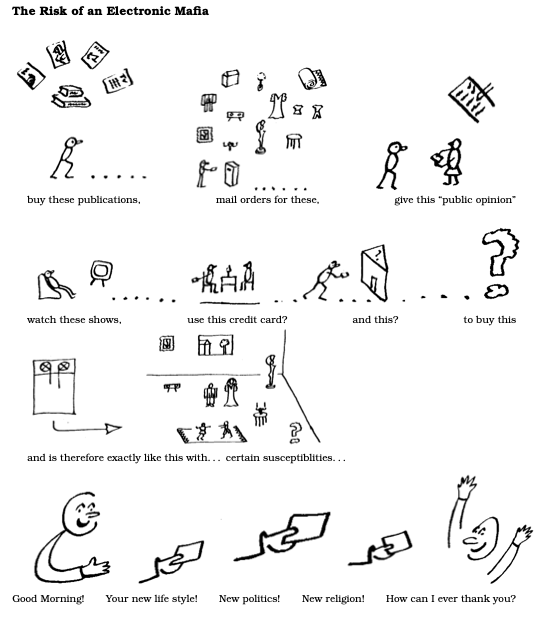
Note that the Electronic Mafia that Beer feared was perfected with the advent of Google AdWords in the year 2000, perpetuated in all subsequent advertising-funded services on the internet.
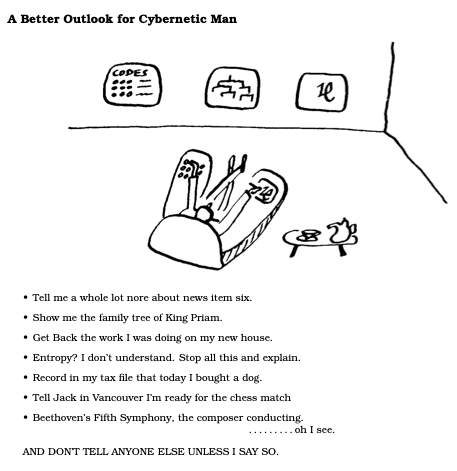
This better outlook for Cybernetic Man is best exemplified by Wikipedia, which started service on 15th January 2001.
You can listen to this half-hour lecture here.
V The Future That Can Be Demanded Now
So it’s thanks to that Magna Carta
that was signed with the barons of old
that in England today we can do as we like
– so long as we do as we’re told.
Beer starts this Talk by reference to the dispute between King John of England and his Barons which led to them forcing him to sign Magna Carta in 1215 CE. This was a classic dispute about centralisation of power versus decentralisation of power – a perennial debate that never seems to resolve itself.
He states that this is really a false dichotomy. Any viable system manages this by using a model of itself within its environment to direct attention to what matters, while filtering out irrelevant signals. If the model has requisite variety to cope with perturbations in the environment and the right channels connecting it to its sub-systems, the balance between the centre and the sub-systems can be maintained.
If we make a terrible mess of interpreting these simple cybernetic discoveries in our society, and I feel that we do, it is because there is no agreed machinery for settling clearly which parts of the system are which. To do so is indeed virtually impossible unless the models in question are made explicit for each level of recursion. To remind ourselves: a level of recursion is a level at which a viable system is in operation, as an autonomous part of a higher-level viable system, and containing within itself parts which are themselves autonomous viable systems. We spoke of this set-up before as being like a set of Chinese boxes.
He illustrates this with reference to the way a family balances the freedom of their growing children with the need to keep them safe. Many of us have experience of just how difficult this can be, but we mostly manage it by a continuous process of negotiation as circumstances change.
This process tends to work badly at higher levels of recursion:
A well-intentioned corporation or national service tries to hang on to its systemic policy – because this is what makes it itself, this is what embodies its aims, this structures its regulatory model. But that policy is centralizing. Then the corporation and the national service, being well-intentioned, embark on high-variety negotiations with the parts of the system, in order to delineate autonomy—which they really wish to be maximal. But the tools they are using are not cybernetic tools, that undertake variety engineering, but administrative tools which do not. As we have several times noticed, bureaucracies install amplifiers in one loop of the homeostat when they should be installing attenuators in the other – and vice versa.
This leads to all-round dissatisfaction and disenchantment:
I often reflect that our organizations are so constructed in their typically pyramidal shapes, so that they could work only if the people in them grew bigger heads as they became more senior. In that case, of course, there would at least be a chance that they could maintain requisite variety. However, as we know, everyone’s head is roughly the same size – except, perhaps, metaphorically.
Bureaucracies try to settle these issues by imposing general rules in the name of fairness, but this is the wrong way to attenuate variety:
The variety attenuators to use here are not policy documents from the centre, but the managers themselves. That is what managers are for. As to the criterion of fairness, the manager – or any individual, in whatever he does – ought to be ready to take responsibility for his own decisions. Our society militates against that morality (for that is what it is) with all its force – in the name of an efficiency which is thoroughly bad cybernetics, in the name of a fairness that is manifestly unfair. But please remember the precept: each of us should take responsibility for his own acts. The practice is precisely the contrary.
Beer now examines the claim that institutions cannot be changed because “there is a resistance to change”. He denies that this is true, except where people are threatened with an end to their means of livelihood. People without social power have no choice in the matter, but those who have that power also have the means to maintain it:
Now I have come to what I consider to be the explanation of the abuse of science and technology in our society. The power has remained where it resided. The tools of modern men have been disregarded at this level of recursion. And there is none left to say a loud NO to that – until the people themselves say No. So this is why I contend that we are considering a future that can be demanded now.
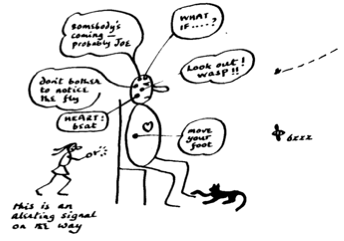
Beer introduces the term homeostat at this point, to refer to a mechanism that keeps a variable, such as your body temperature, constant. The most important homeostat for any system is its ability to remain in existence despite changes to its environment. This ability to maintain existence is known as autopoesis – which comes from the Greek for “making itself”.
The problem with bureaucracy is that it tends to become pathologically autopoetic – to become a parasite which lives at the expense of its host, instead of in service to it.
Beer counters the typical objection that change would cost too much by making the following observations:
A little time ago I said that there were two barriers to progress, and that the first is bureaucracy. The second is the availability of money. But I have dealt with this question before, and need only summarize my answers now. Essentially, the costs associated with major projects are unreal.
Point One:
they usually represent not the actual costs, but the availability of funds.
Point Two:
the availability of funds is divided into arbitrary time epochs, which match the requirements of accountancy and not the needs of the people.
Point Three:
the people are paying for the projects anyway, one way or another, but this fact is disguised from them.
Point Four:
there is as yet no way in which the people can decide on which projects their money should be spent.
Point Five:
there is no reason why spending money according to the wishes of the people should cost more than to spend it according to the wishes of the bureaucracy, provided that the central regulatory model has been democratically composed, and is properly understood.
Point Six:
and this is new: the cost of many new societary projects could be met from savings made by dismantling the bureaucracy.
….
Then the concept of freedom is not meaningful for any person except within measurable variety constraints; and the extent to which we have lost freedom is due to loss of control over the variety attenuators – education, publishing – and to the centralization of power at the wrong levels of recursion. This freedom could be reclaimed, using the new scientific tools at our disposal, but only if new democratic machinery is established to replace existing bureaucracies. As long as these remain cybernetically organized so as to produce themselves, our societary institutions remain set on courses that lead to catastrophic instability.
You can listen to this half-hour lecture here.
VI The Free Man in a Cybernetic World
The continuous process of liberating our minds from the programs implanted in our brains is a prerequisite of personal evolution. We can embark on that process of liberation only by constantly and consciously testing the ways in which our personal variety has been and is being constrained by the very things we tend to hold most dear.
….
As I said at the very beginning of these talks, a lot of people feel trapped.
….
But I would like to make sure that you hear the following words, which form a conclusion drawn from his own cybernetic analysis of the societary condition by Sir Geoffrey Vickers. He says: “The trap is a function of the nature of the trapped.” Then I should go on to say that the failed society that I have depicted to you is not a malevolent society, not a cunning trap – for I agree with Vickers that the “trappiness” of the trap lies in our own nature. It may be nearer the mark to speak of a Dinosaur society.
By this epithet I mean to say that the trouble with our institutions is in their loss of the ability to respond in time, to learn in time, to adapt and to evolve. Like the dinosaurs, they cease to be viable systems. I have tried very hard to lay bare the mechanisms that appear to me to lead to this disaster, because I think they can well be understood. What we understand we can control.
….
Civilization is being dragged down by its own inefficiency. We cannot feed the starving; we cannot stop war; we are in a terrible muddle with education, transportation, the care of the sick and the old; institutions are failing, and often we feel unsafe in the streets of our own cities. All this is inefficient. Then it cannot be correct to say that the only way to preserve liberty is to be so damned inefficient that freedom is not even threatened. We have to become efficient in order to solve our problems; and we have to accept the threat to freedom that this entails – and handle it.
….
And so my first conclusion to these lectures is: efficiency does not entail tyranny – if we can get the system right. To do so is a top priority, because some version of efficiency is required to save our dinosaur society.
Beer goes on to suggest that the technical infrastructure to enable the real-time, democratic decision-making he envisages should include (and I am quoting him here):
“High-variety, realtime, broad-band circuits available to all.”
“Free computer power so that people could engage in their personal evolution – by guiding their own learning, and editing their own input.”
He suggests that these services should be free public utilities.
He suggests that new institutional forms should be developed by people coming together to pilot them on a small-scale, finding which ones work, then scaling them up. This is, after all, the experimental approach which is the essence of the scientific method.
He comments on the tragedy of the way this kind of work in Chile was undermined by international pressure, then overthrown by a violent military coup.
He ends on a positive note:
Let us use love and compassion. Let us use joy. Let us use knowledge. These qualities are in us, obscured though we may let them be by the lethal strategies of our dinosaur society. And let us use that acquired and ordered knowledge: science. This too is in our heritage. If it has been seized by power, then seize it back. Expect it of statesmen and politicians who represent us that they should, on our behalf; or demand a new breed of statesmen and politicians. Expect it of educators that they should change the institutions of education not to train crazy apes; or start new schools and universities instead.
Above all, let us all expect it of each other that we find ways to use the power of science in better cause. It is no more sensible to say that we cannot, because ordinary folk do not understand science, as it would be to say we cannot sail a boat, because we cannot understand the wind and the sea and the tide-race.
Men have always navigated those unfathomable waters. We can do it now.
You can listen to this half-hour lecture here.
Having summarised Designing Freedom, my next post will consider some key questions:
Given the accuracy of this diagnosis, addressed to the well-informed Canadian public in 1973, why has nothing apparently been done to Design Freedom since then?
In 1973, the technical infrastructure to enable Designing Freedom barely existed. That infrastructure is now available worldwide, so why isn’t it being used to Design Freedom now?
Great work Trevor. Beer was so far ahead of his time, wasn't he?